Your three closest competitors — and whether you’re above or below them.
Enter your web address. We read your site the way a buyer comparing you reads it, name the firms they see you next to, and score every one of you on the same rubric. Each claim is either measured from the page or labelled as inference.

You can see everyone who called you.
You cannot see anyone who decided not to.
Every enquiry you receive is measured. Source, value, close rate, cost per lead. It is the best-instrumented part of the business and every number in it is true. It is also, without exception, drawn from people who had already decided to contact you.

So consider what those numbers can and cannot tell you. Suppose your conversion rate went up last quarter.
Three things it can mean
You converted better.
The same people arrived and more of them chose you. This is the reading every dashboard implies.
Fewer of the wrong people reached you.
Your mix improved. Fewer enquiries, better fit, a higher rate — and a smaller market than you think you have.


Fewer people reached you at all.

The rate rose because the denominator fell. This reading looks identical to the first one on every chart you own.
All three produce the same figure.
There is nothing inside your business that separates them, because everything inside your business is calculated from the people who made contact. Which of the three it was is the only question that matters, and it is the one question your reporting is structurally unable to answer.
Silent omission inflates the score.
That is not a slogan. It is a rule this software runs under, written for engineers, and inside the scanner it governs pages. If a rubric item is missing from a site — no fees page, no team page — it is recorded as missing rather than skipped. A firm scored only on the pages that loaded looks better than it is.
Read it again as a rule about buyers. A buyer who removes you without telling you makes your conversion rate go up. One sentence, two applications, and no invention in either — it is the same arithmetic twice.
Nobody here has made a mistake. You optimised against the numbers you had, and those numbers were accurate. Every one of them was drawn from someone who had already decided to call you, which is not a flaw in your reporting. It is a property of reporting. You cannot instrument a decision that was taken about you, elsewhere, by someone who never announced themselves.
The shortlist is short, and it is drawn before you hear about it.
This is the part that is not arithmetic. Two research firms, with different instruments, different samples and different years, arrive at the same picture — which is about as close to a settled finding as this territory offers.
95%
of the time, the vendor that won was already on the buyer’s day-one shortlist.
6sense, 2025 B2B Buyer Experience Report≈4,000 respondents
94%
of buying groups had ranked a preferred vendor before making first contact — and bought that favourite 77% of the time.
6sense, 2025 B2B Buyer Experience Report≈4,000 respondents
2.7
firms on the average shortlist. 83% of buyers shortlisted three or fewer.
TrustRadius, 2026 B2B Buying Disconnect1,862 buyers, fieldwork January 2026
92%
of buyers begin with at least one vendor already in mind. Forrester’s own conclusion: B2B buying is “a process of confirmation, not selection”.
Forrester, B2B Marketing And Sales Are Too Late To Influence Decisive Buyers, 20252024 Buyers’ Journey Survey; sample not publishedReport is client-only; figures held via Digital Commerce 360, 7 July 2025
And the page they would have read is being opened less.
Two measurements of search behaviour, stated as exactly that. They do not show that assistants have replaced search — McKinsey puts AI-enabled search level with Google, not above it, and assistants still refer under one per cent of web traffic. What they show is narrower: more of the answer is being composed before anyone arrives on a website at all.
68%
of US Google searches ended without a click on any result.
Similarweb / SparkToro, clickstream analysis, 2026January–April 2026
8%
of visits with an AI summary ended in a click on a result, against 15% of visits without one.
Pew Research Center, study of Google search behaviour, 2025900 US adults, 68,879 searches
Every study above measures enterprise and technology buying. Nobody has measured the sub-£2,000 UK professional-services decision — including us. Applying these figures to a firm of that size is an inference, and this is us labelling it as one.
You will notice there is no figure here for buyers using an AI assistant to build a shortlist. That is because nobody has measured it. Every number in circulation is published by a company selling into the market it describes, and one publisher’s own two waves moved from 7% to 63% in a year on question wording alone. We published a study in August that claimed more than its method carried and withdrew it the next day. This row is missing on purpose.
We ran it on ourselves first. It scored us 41 out of 100.
Before asking anyone to accept a number from this instrument, we turned it on the firm selling it. It read audienceintel.app through five buyer archetypes and returned an average of 41, against a baseline of 60 for a competently built professional-services site. Five readings out of five fell short. The report is published in full.
“Open access from late May 2026.” It is May 11th. So I can’t even buy this today. Closing the tab.
Prediction discipline — stated against us
The operator’s predictions file at docs/methodology-pack/self-test-predictions.md was, at the time of run, empty. The operator was writing predictions in parallel to the run. The unpredicted findings — anything in this report not on the operator’s prediction list — are the methodology’s proof.
We would not ask a firm to accept a number from an instrument we had not first turned on ourselves.
How it works
Four steps, and the real output of each one.
Everything below is rendered from reports this software actually produced — including the one where we pointed it at ourselves and did not like the answer.
01 · You give us a URL
One field. No account, no call.
We fetch your site the moment you press the button and read it the way a buyer would — what you do, who for, what it costs, who to trust. Nothing is taken on faith from a form.
One field → your firm identified
- Given
- https://audienceintel.app
- Firm
- audienceintel.app
- Read
- 11 May 2026
02 · We score you the way a buyer reads you
Not one visitor. Several, who want different things.
A cautious first-timer and a buyer already comparing three firms read the same page and need different things from it. Each is scored separately, with the reason attached — so a decent average can’t hide the one buyer you lose every time.
Every archetype scored separately, with its reason
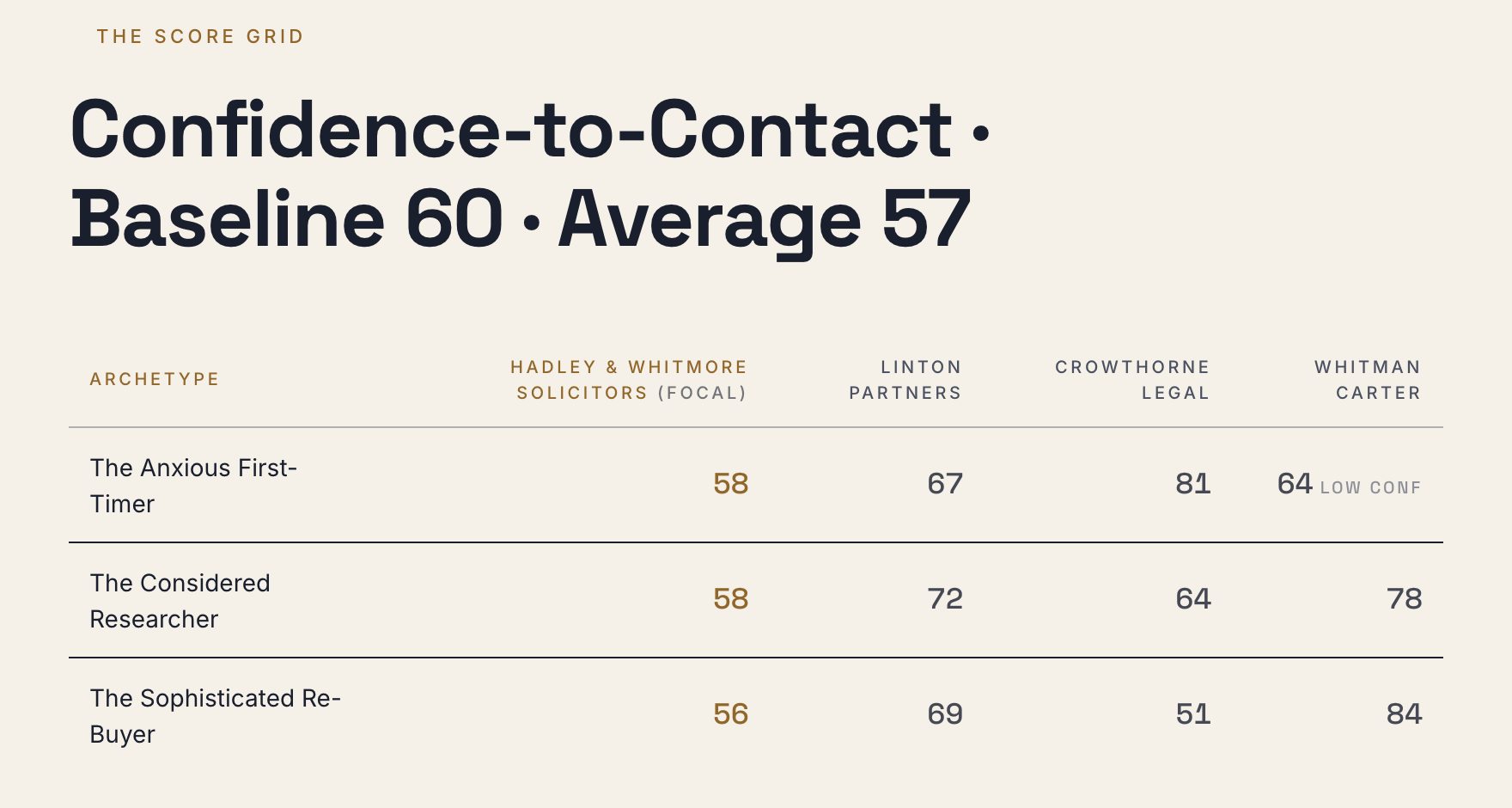
- 58The Anxious First-Timer
- 58The Considered Researcher
- 56The Sophisticated Re-Buyer
A reference firm, constructed to demonstrate the method. Not a trading business.
03 · We put your rivals beside you
Not a score in isolation. A position.
Name your competitors or let us find them from the register. Each is read on the same rubric, so the number means something: it is where you sit, not how you feel.
3 rivals read on the same rubric
The Anxious First-Timer58-23 v best
Best on this reading: Crowthorne Legal, 81.
The Considered Researcher58-20 v best
Best on this reading: Whitman Carter, 78.
The Sophisticated Re-Buyer56-28 v best
Best on this reading: Whitman Carter, 84.
Reference firms, constructed to demonstrate the method. Not trading businesses.
04 · You get what to change
Ranked by what it moves, with an owner.
Not a list of everything wrong. A short ordered list of what to do next, what each one is expected to shift, how much work it is, and who in your firm owns it.
Ranked by expected movement, not severity theatre
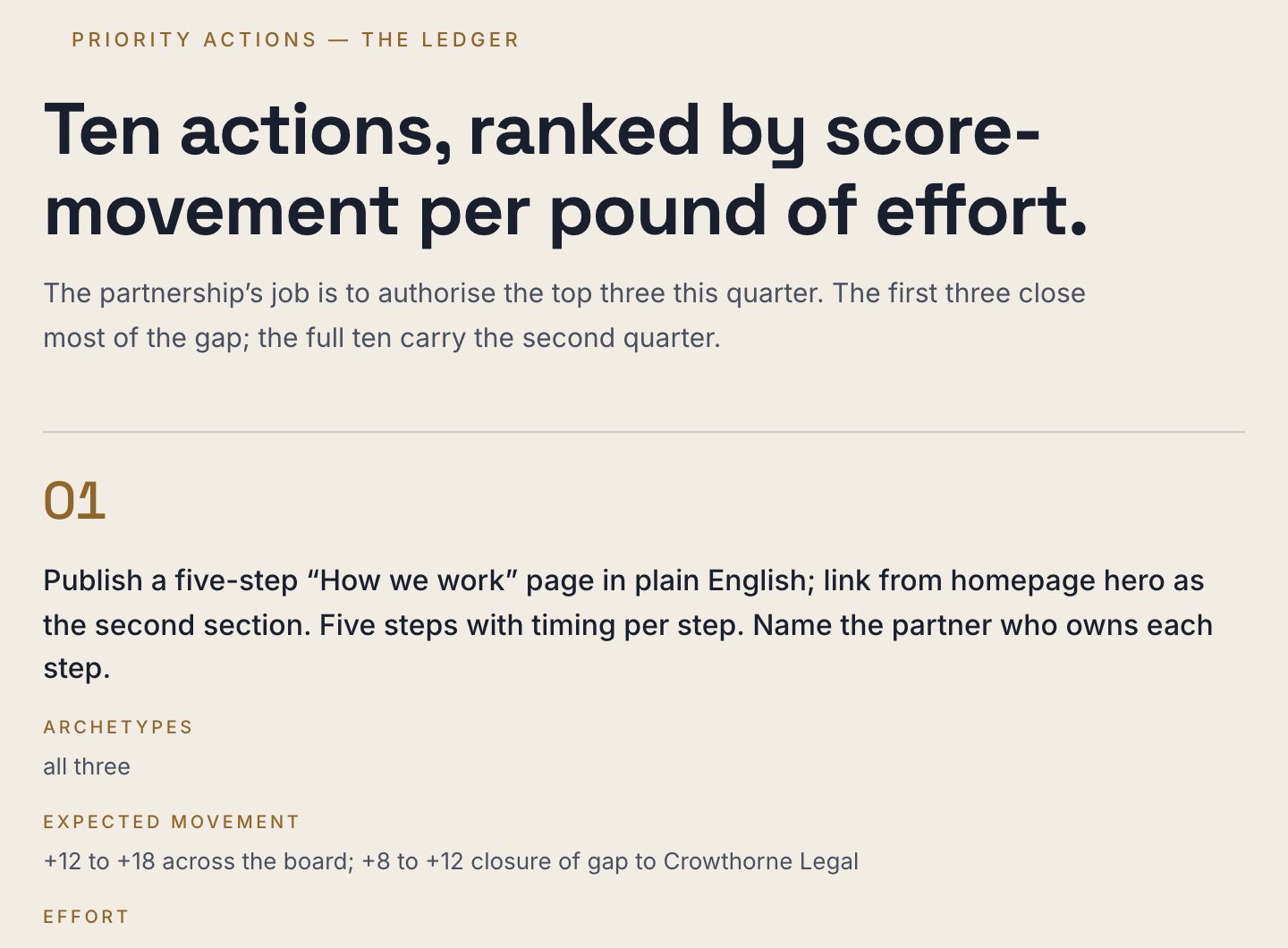
- 01
Publish a five-step “How we work” page in plain English; link from homepage hero as the second section. Five steps with timing per step. Name the partner who owns each step.
low effort · copywriter + senior partner, 1 week
- 02
Replace the stock courthouse hero with a photograph of the actual team in front of the Cheltenham office (similar to the pre-rebrand hero). Caption: “The Hadley & Whitmore team, Cheltenham.”
low effort · photographer + designer, 2 weeks
- 03
Move SRA registration into the header; add Lexcel + Conveyancing Quality Scheme badges if held; if not held, apply for the latter (£800, ~3 months). Add a footer link to the firm’s complaints procedure.
low effort · partner + admin, 1 week + 3 months
Ask an assistant which firm to call. This is the answer it gives.
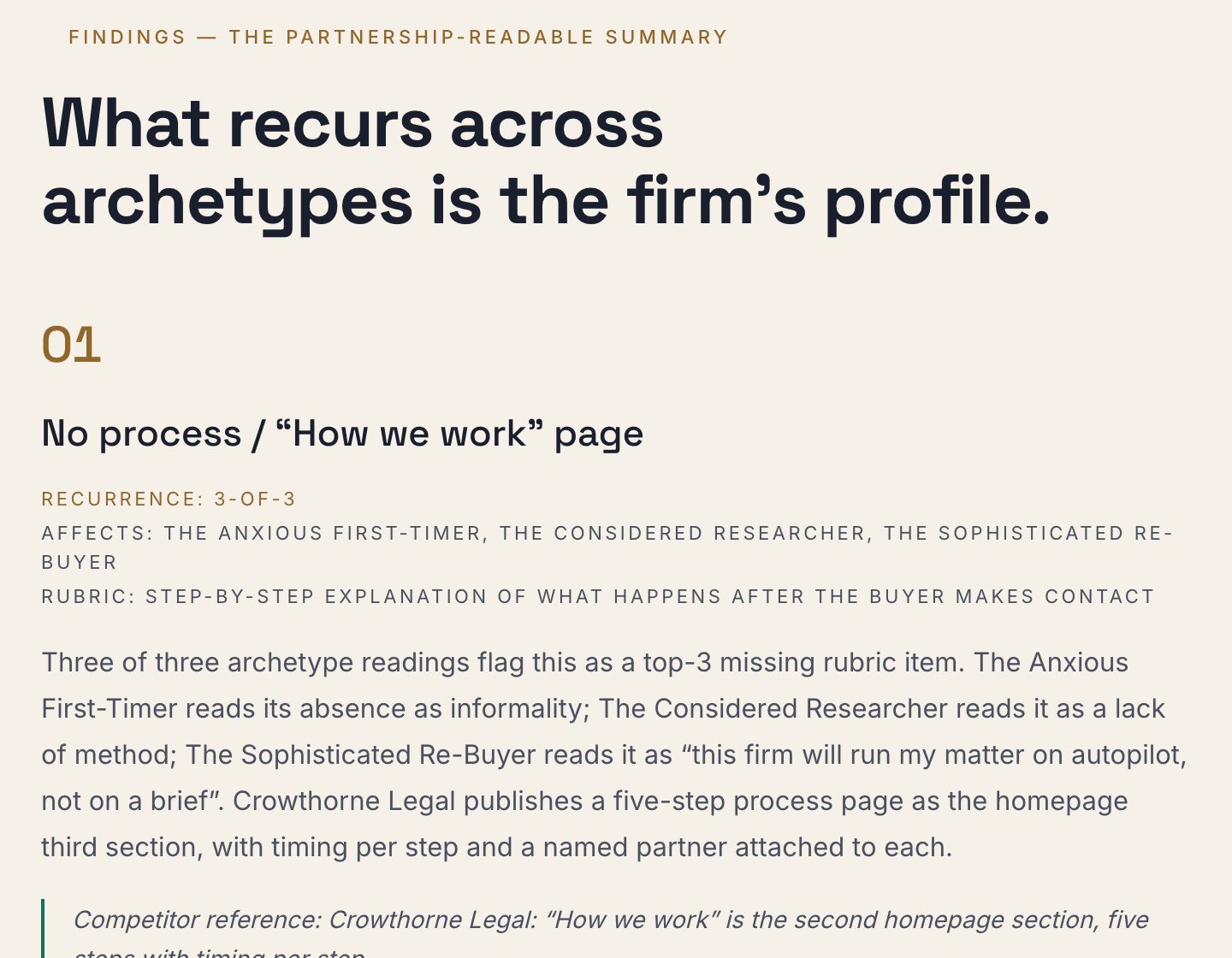
“I open Crowthorne Legal’s tab next, which has a fixed fee on the homepage and a five-step process I can read in two minutes. I’m probably going to call them first. My probability of contacting Hadley & Whitmore today: 55–60%.”
The data that wins your audience is scattered. We connected it.
What decides your market sits in a dozen places — assistants, search, maps, the public record, the trade forums. Reaching it yourself means 14 credentials across 11 vendor accounts, each with its own sign-in, rate limits and answer format — and 2 of them refuse anyone who asks without one.
So one agent sits in front of all of it. It asks each source, checks the answers against each other, drops whatever only one of them says, and reads the rest against our own research. What reaches you is the finding and where it came from. A source that does not answer produces no line in your report — we never fill the gap with an assumption.
Wired in, not promised. A source that does not answer produces no line in your report rather than a filled gap. The four assistants are the multi-engine read, which is a tracking-tier option, not part of every run.
Not another SEO audit.
- We don’t grade your keywords. We read what AI assistants actually conclude about you.
- Every claim is labelled measured — checked in your site’s code — or inferred — the AI’s reading.
- No number ships without a source. If we can’t trace it, you don’t see it.
Four ways to read it. Same report behind all of them.
In your browser
The live report, built section by section in front of you.Run it →Branded PDF
Delivered by email within 48 hours, with a private web version.See pricing →API access
A scoped, spend-capped REST API. OpenAPI 3.1 spec published.Read the docs →MCP for Claude & your AI tools
A remote MCP server — ten tools your own AI clients can call.Read the docs →
Run it free. £27 unlocks all of it.
One price, and you only pay it once you have seen what the report found. There is no subscription to start and nothing to cancel.
£27
One payment · no subscription
We read your website and your market live, in front of you, and build the report for nothing. £27 then opens every held-back section, for good. If it doesn’t surface findings your firm would act on, reply to your receipt within 90 days and we credit it back.
Run your free report →- Free to run
- No account needed
- Your real site, read live
Running this across a portfolio, or want us to do it for you? See the full range →
No testimonial wall. 30 sources and the work they produced.
We publish the research instead — read it and judge the desk yourself.
- What a relaunch actually moved
- Windows, Doors & Double Glazing: who owns the market?
- The State of UK Cut-to-Size, 2026
- What your market is screaming for
- The falsification test — what an LLM produces with only our homepage
- The Zero Moment of Truth, fifteen years on
- Where the numbers came from — sixteen B2B buying statistics, checked
- Thirty verified sources, with pull-quotes